Buying a drone in the Netherlands: the rules and what you actually need
Drone rules have tightened considerably in recent years, and that is not always obvious when you see a model in a web shop. Here is what applies in the Netherlands, in plain language.
The 250 gram line
If your drone weighs under 250 grams you fall into the lightest category and you do not need a theory exam. If it has a camera, and almost everything does, you still have to register yourself with the RDW as an operator. That costs a few tens of euros a year and you get a number to stick on the drone.
Above 250 grams it gets more serious. You need to pass the online A1/A3 exam. It is manageable, an evening of study, but it has to be done before you take off.
Where you may not fly
- Within three kilometres of an airport, and much further around Schiphol.
- Over crowds, always, regardless of weight.
- Higher than 120 metres.
- Beyond your line of sight. FPV goggles are only allowed with a second person watching.
- In many nature reserves, particularly during nesting season.
The government drone map app is the fastest way to check whether a spot is clear. Do that before you leave, not once you are standing there.
Which specifications matter
Weight comes first, for the reason above. Note that manufacturers sometimes quote weight without the battery. Ask for the take off weight.
Gimbal. This is the difference between usable footage and a clip nobody finishes. A mechanical three axis gimbal keeps the camera still while the drone moves. Electronic stabilisation is a workaround that visibly falls short in wind.
8K on the box. Be sceptical. Many cheaper models interpolate: the sensor shoots 4K and software scales it up. Look at sensor size, not pixel count.
GPS and return to home. Without GPS a drone drifts with the wind and will not come back by itself. For flying outdoors this is not a luxury.
Flight time. Manufacturers quote still air with no manoeuvring. Count on 70 percent of that. A second battery is almost always a better investment than a slightly more expensive drone.
Two examples from our range
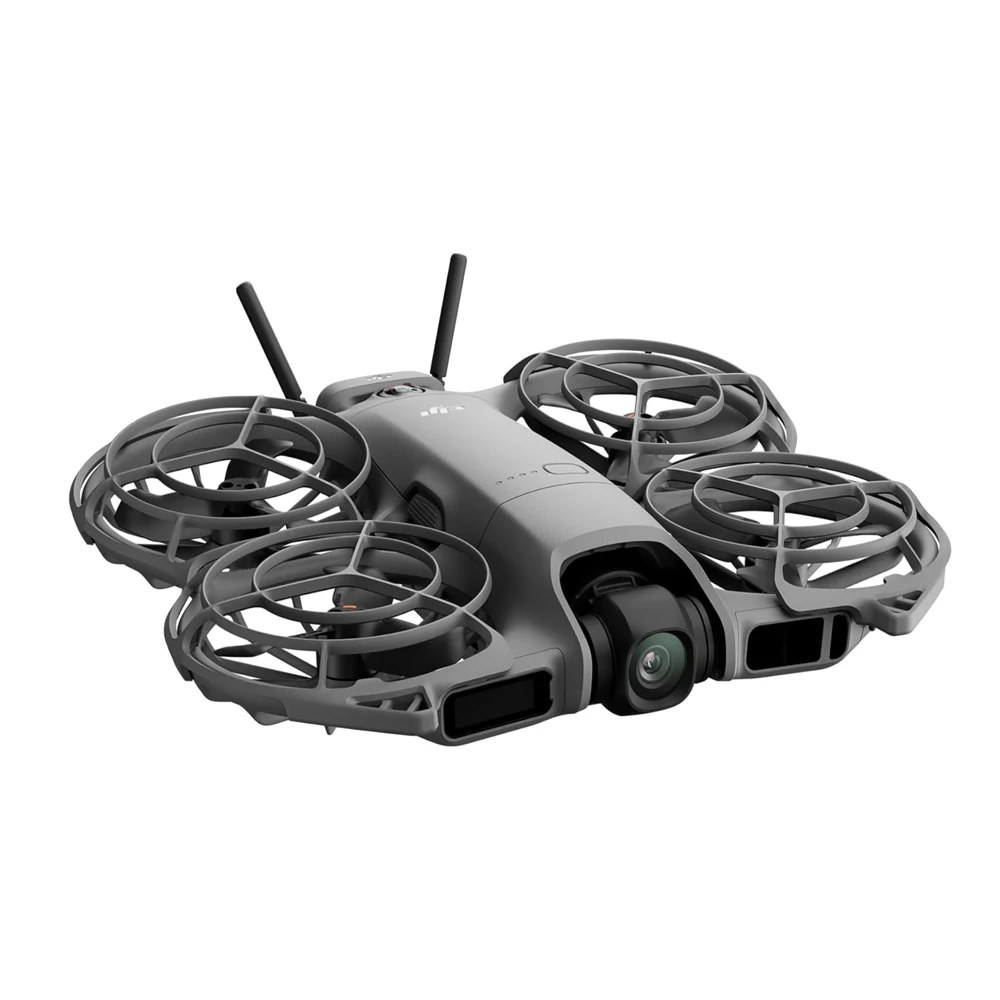
The DJI Neo2 comes in under 250 grams, so no exam, and has the stabilisation DJI is known for. The V168 Pro MAX is considerably cheaper with GPS and return to home, but falls in the heavier category and the 8K is upscaled. That is not a problem as long as you know it.
Before you order
Think about where you will actually fly. If you live in a built up area, a large part of your surroundings is restricted, and a light drone you take outside beats a heavy one with long range. You will not use that range anyway.