
Power station for camping: how many watt hours do you need?
Power stations are sold on one big number, and that number means little without your own list next to it. Here is how to work it out, and where the brochure misleads you.
The calculation
Watt hours (Wh) are power times time. A cool box drawing 45 watts that actually runs four hours a day costs you 180 Wh per day. Note the word actually: a compressor cool box is off most of the time, so count roughly a third of the time rather than twenty four hours.
An average weekend looks like this:
- Cool box: 180 Wh per day
- Charging two phones: 30 Wh
- Laptop for an evening: 60 Wh
- LED lighting: 20 Wh
That is almost 300 Wh a day. For three days without recharging you need around 900 Wh.
Why you need more than you calculated
Two things eat capacity. The inverter turning DC into 230 volts runs at roughly 85 to 90 percent efficiency, so anything you plug into a socket costs 10 to 15 percent extra. And you do not want to routinely drain lithium to zero if you want it to last.
So add about a third to your result. Those 900 Wh become 1200 Wh in practice, or you accept recharging halfway.
Solar panel, or not
A 200 watt panel in northern Europe delivers somewhere between 700 and 1000 Wh on a good summer day. On a cloudy October day that can drop to 150. That is not a fault, that is the weather.
Important: do not lay the panel flat. Angling it towards the sun easily gains 30 percent. And one branch of shade across a panel costs disproportionately much, because the cells are wired in series.
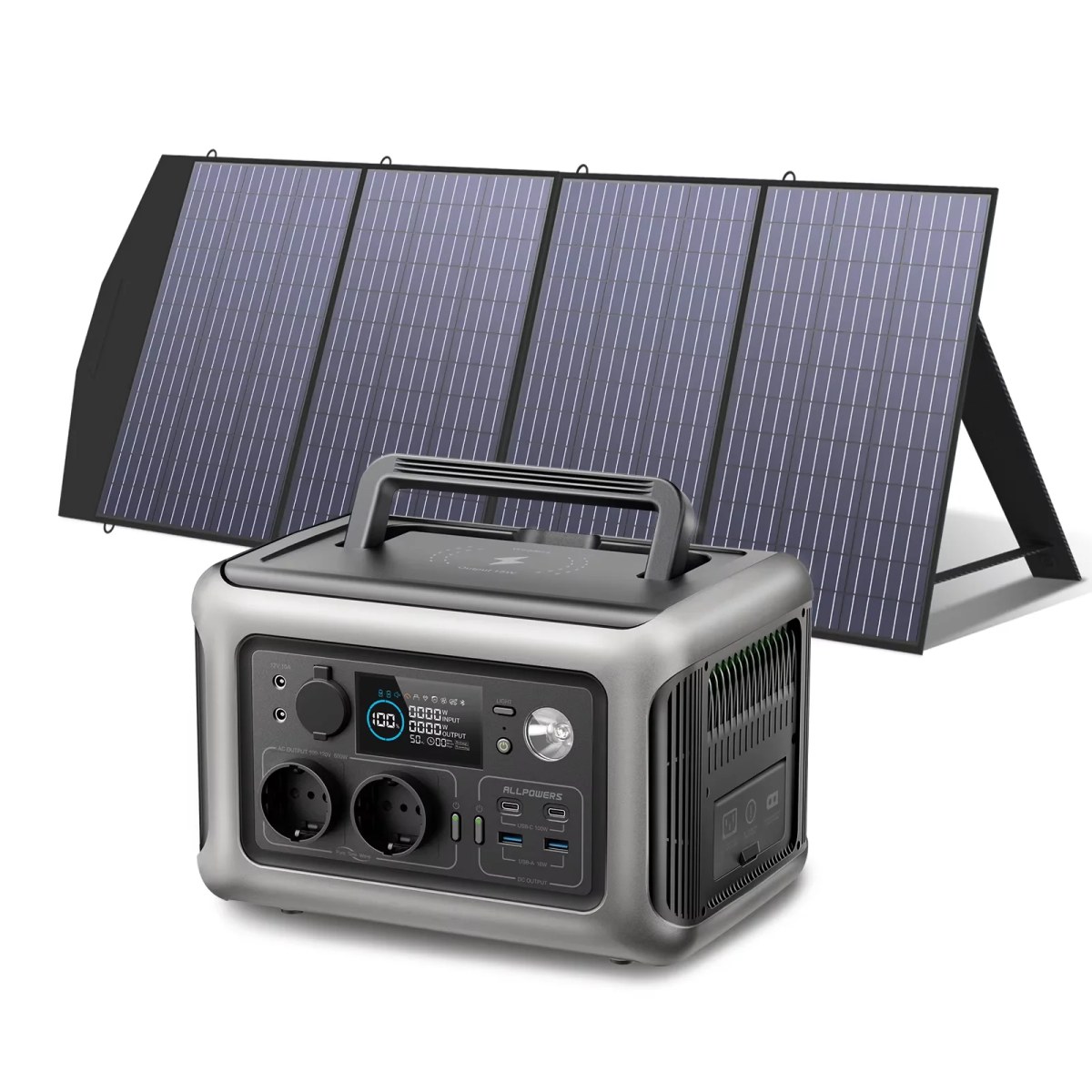
Our portable 600W solar generator with 200W panel is the combination that works for most campers: enough to keep a cool box running and top it back up during the day.
What else to check
- Peak output. A kettle or hair dryer pulls 1500 to 2000 watts. If your station says 600 watts, that will not work no matter how big the battery is.
- Cool box connection. If your cool box runs on 12 volts, use the 12V output rather than the socket. You skip the inverter and save around a tenth of your consumption.
- Cell type. LiFePO4 lasts roughly three times as many charge cycles as regular lithium ion and handles heat better. On a station you want to keep for years that is worth the money.
- Charging time from mains. Some stations take eight hours. If a campsite only gives you power for a couple of hours, that is a problem.
The honest conclusion
For a weekend with a phone and some lighting, 300 Wh is enough and you carry nothing heavy. Add a cool box and you quickly land at 600 Wh or more. And anyone going away for a week without shore power does not really need a bigger battery, they need a panel.